Diversity and potholes
Fixing the underrepresentation of transgender pothole-related cycling crashes

My local cycling club enjoys weekly races around local country roads under the auspices of AusCycling and with permission from the police and the Surfcoast Shire. We race at what Tour de France commentators would call a very leisurely pace, despite the average heart rate being elevated on most competitors’ computer sensors to the ‘threshold’ level for an hour or more. We’re pretty tired by the time we roll over the line. Add in the fact that the Wednesday crew is the Super Vets (60 +), the cuppa and cake afterwards is very welcome.
Like the pros (at least, we like to think), we ride closely bunched in handicapped groups of 3 or 4, separated by a few minutes to give the slower riders a fighting chance of being in the action at the finish. We take turns on the front, and ride in each other’s slip stream where we can.
There’s a small amount of chat - when the heart rate is 160 bpm, brevity is highly valued. Some jargon helps communicate:
“Up the road” - indicates the lead rider should move to the centre of the road to help those behind to shelter from a cross-wind (“down the road” is the alternative if the wind is coming the other way).
“Ease up” - indicates the lead rider is going too fast for the rest of the bunch, risking losing one or two ‘out the back’ and with them the advantage that a larger bunch has over a small one.
Given the state of the road surface on our preferred, and sanctioned, race routes, another common shout is simply “Pothole!”
When the call comes too late, consequences can be dire. Tyres can be damaged, wheels and frames, paintwork can get scratched, bent or snapped, clothing can be ripped. Oh, and bones can be broken, too.
Surfcoast Shire has quite a large network of roads to ‘maintain’. And they have other priorities, too, on which they spend ratepayers’ hard earned money. One of these priorities is the ‘Fair Access Policy’, and they have helpfully provided our club with a copy of their “Gender Inclusive Sports and User Group Toolkit”. The Shire has invited our board to use the guide to ‘self-evaluate your club’s inclusion.’ The material also includes a “section for you to list specific action plans that arise from your club’s self-assessment.”
But wait there’s more: to show the world how inclusive the club is, the Shire has “also attached promotional material that we would really like your club to use in any social media, online-platforms as well as physical/digital displays in your facilities.”
Not only that, but the Shire suggests
“We would appreciate your club or committee to do the following by 20 September:
Complete attached Gender Inclusive Sports and User Group Toolkit for your club.
Utilise attached promotional material (Level the Playing Field & We’re A Fair Access Club)
Complete attached Fair Access Action Plan – Club Progress spreadsheet to report your clubs Year 1 actions from the attached Fair Access Policy Action Plan.
Helpfully, the first page of the toolkit includes this definition: “…When referring to women and girls, it inherently includes transgender and gender-diverse women.”
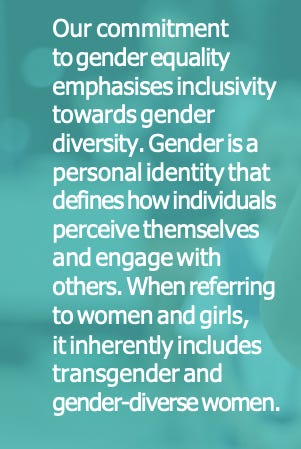
This is the only occurrence throughout the document of the word ‘transgender’, so it is important to remember this definition when reading the rest of the material.
For example, under the heading “Why is gender diversity important” we read:
Most people agree your gender should not get in the way of you leading the life you choose. Yet too often, women and girls who want to participate in community sport are not able to participate in the way they would like to due to outdated cultures, policies and practices and unsuitable facilities or funding arrangements that prioritise the men’s and boys’ teams. Sporting Clubs have a responsibility to ensure that their club is welcoming and inclusive for women and girls.
On its face, a reasonable enough statement. But bearing in mind the definition of ‘women and girls’ at the start of the document, It could probably be rephrased as follows:
Most people agree your gender should not get in the way of you leading the life you choose. Yet too often,
women and girlstransgender people who want to participate incommunitywomen’s sport are not able to participate in the way they would like to due to outdated cultures, policies and practices and unsuitable facilities or funding arrangements that prioritise the men’s and boys’ teams. Sporting Clubs have a responsibility to ensure that their club is welcoming and inclusive forwomen and girlstransgender people.
It’s about time we started seeing the correction of the under-representation of transgender people in the statistics of pothole related-related cycling crashes. This initiative from the council will go a long way towards equalising the access to crutches and ICU beds for a whole range of genders. I applaud the council for taking this step.
One thing bothers me though - the tone of the communication from the council still preserves a thin veil of voluntariness when it comes to completing the toolkit self-assessment and the display of signs around our facilities and the deadline for reporting and so on. Things are never going to move quickly enough unless we make it compulsory. If only there were some precedent for mandating something that was none of our business…
That’s hilarious if it wasn’t so serious. Let’s not fix the potholes but make sure all the sexes fall and injure themselves!!
Gawd. .
Voluntary but not.
I reckon copy the Brits and fill those pot holes with the eureka flag.